
Transforming dental care through intelligent automation
Context
I co-founded Sonobe to explore how artificial intelligence could reduce the administrative burden in dental care. The ambition was to create technology that listens during a consultation, understands the clinical context and turns the conversation into structured documentation, allowing dentists to focus on their patients instead of their computers.
Over two highly formative years, we made a significant pivot and developed the concept into a working product. My responsibilities spanned product vision, concept development, UX and product design, as well as the complete Sonobe brand identity. I translated an emerging AI capability into both a coherent product experience and a brand that felt approachable, trustworthy and relevant to dental professionals.
As the company later moved towards opening its own dental practice, its strategic direction changed. At the same time, I could no longer give Sonobe the level of time and focus it required. I chose to step away rather than compromise the quality of my contribution.
Challenge
Dentists need to document treatments thoroughly, but doing so often forces them to divide their attention between the patient and a computer. Notes are frequently completed during or after an appointment, adding administrative work and taking time away from personal care.
Introducing AI created an additional design challenge. The product needed to understand complex clinical conversations, generate useful documentation and fit naturally into an existing consultation. Asking dentists to constantly control, correct or interact with the technology would simply replace one administrative burden with another.
We also needed to build trust in a completely new company and an unfamiliar way of working. Sonobe's identity had to communicate technical intelligence without feeling cold or overly complex, while still feeling credible within a professional healthcare environment.
Approach
We developed Sonobe in close collaboration with dental professionals. Instead of designing the experience around what the technology could do, I focused on how dentists actually moved, communicated and made decisions during a consultation.
We mapped the full journey, from welcoming a patient and performing a treatment to reviewing notes and updating the patient record. This led to a central design principle: the product should work quietly in the background and only ask for attention when it genuinely added value.
Alongside the product experience, I took my first practical steps in AI product development. We trained and tested the model using real-world dental language and evaluated whether its output was accurate, relevant and structured in a way professionals could use. Feedback from the practice helped us refine both the generated documentation and the surrounding interaction.
In parallel, I designed Sonobe's complete visual identity. The branding was developed around the same principles as the product: intelligent but human, innovative but dependable, and distinct without becoming disruptive in a clinical setting. We also explored how Sonobe's data could connect with leading dental record and practice-management systems, preparing the concept to become part of an existing workflow rather than another isolated tool.
Solution
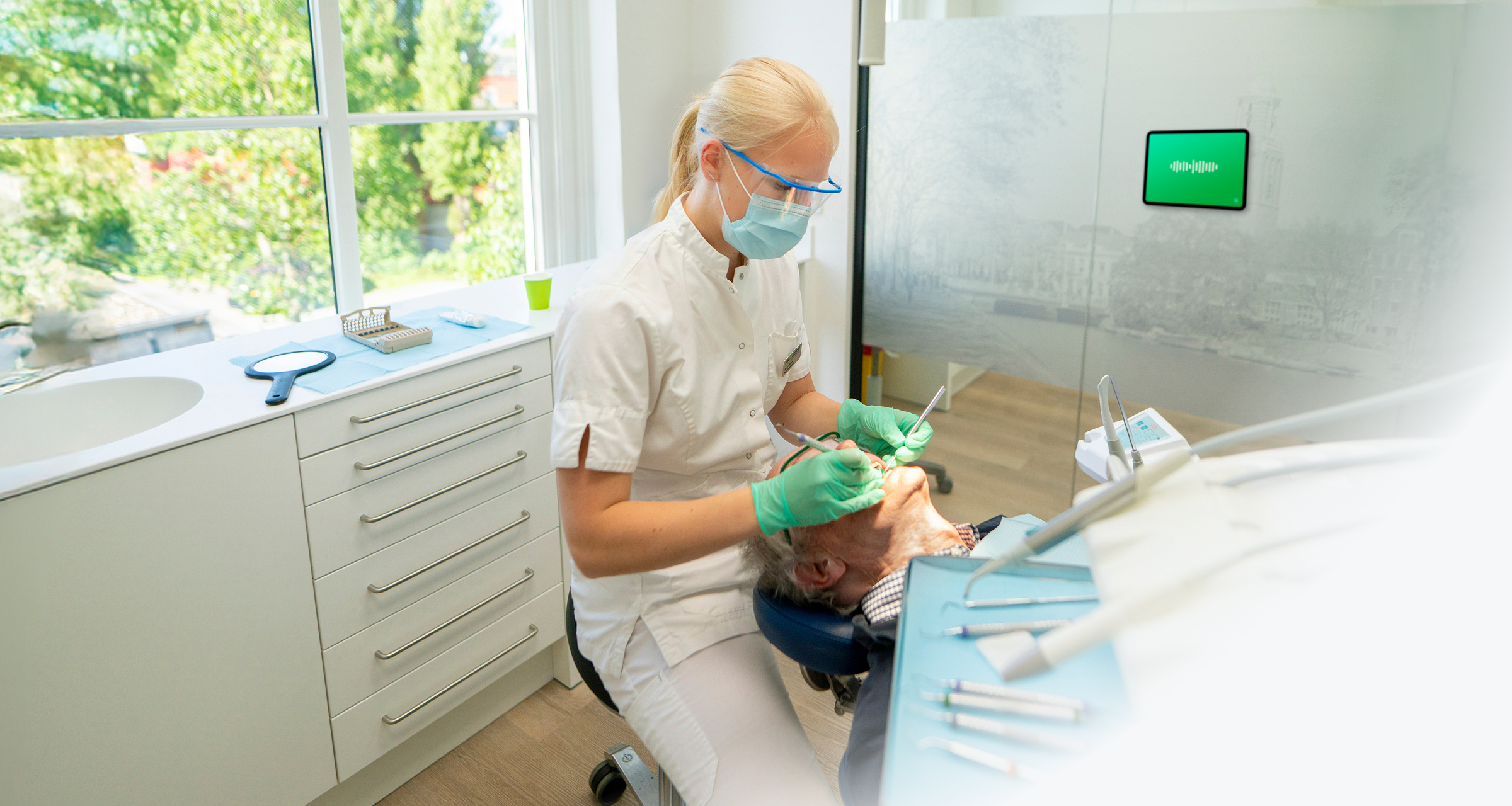
We created an ambient setup designed specifically for the treatment room. A microphone positioned above the dental chair captured the consultation and connected to an iPad running the Sonobe app. This allowed the system to listen without requiring the dentist to operate a device throughout the appointment.
The captured conversation was processed by the AI model and transformed into a structured clinical note. A supporting dashboard organised appointments and allowed the dentist to generate, review and manage documentation for each consultation.
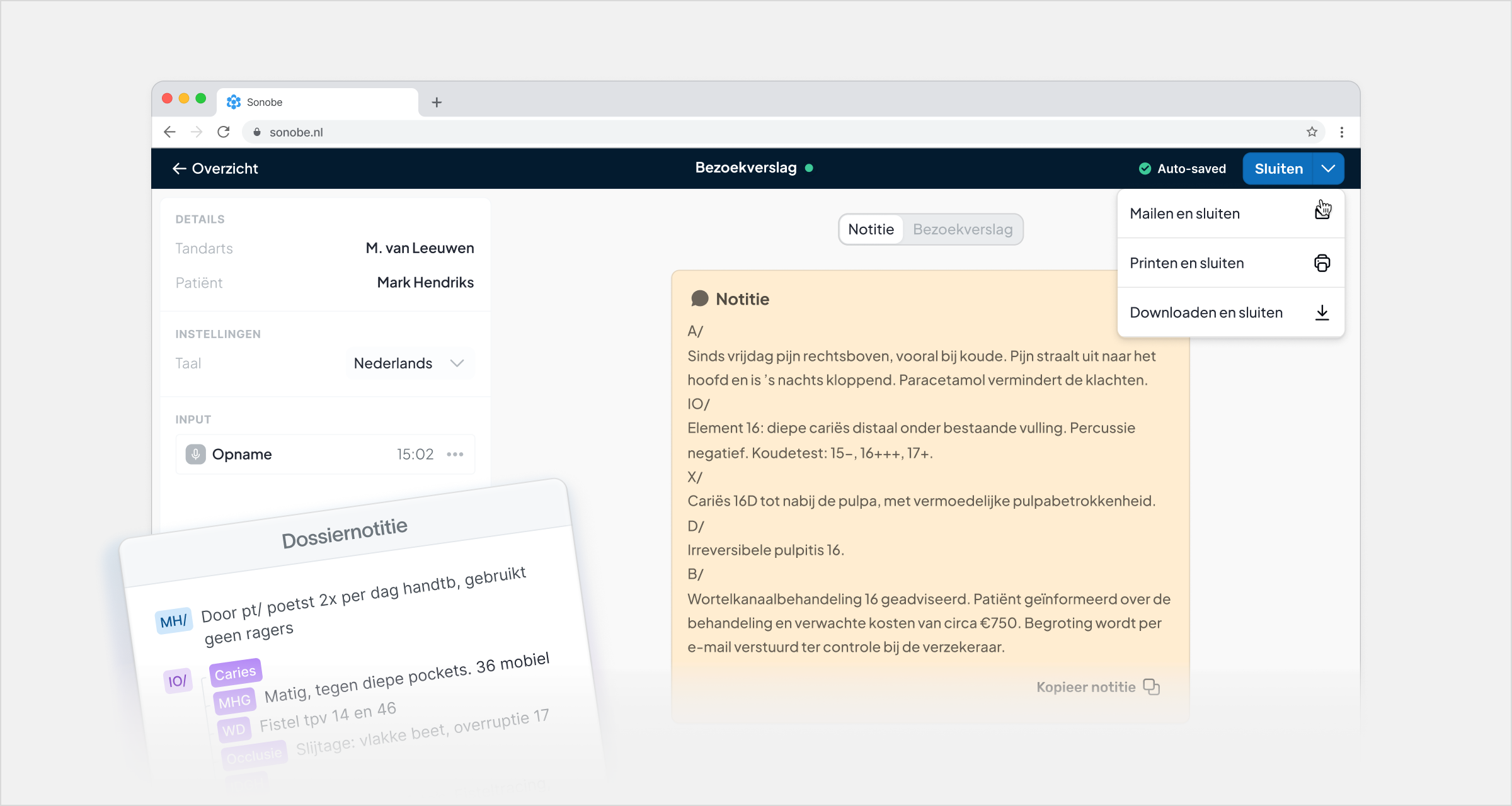
Every part of the experience was designed to minimise interaction. The dentist could remain focused on the patient while Sonobe handled the administrative work in the background. The interface provided control when needed, without making the technology the centre of the consultation.
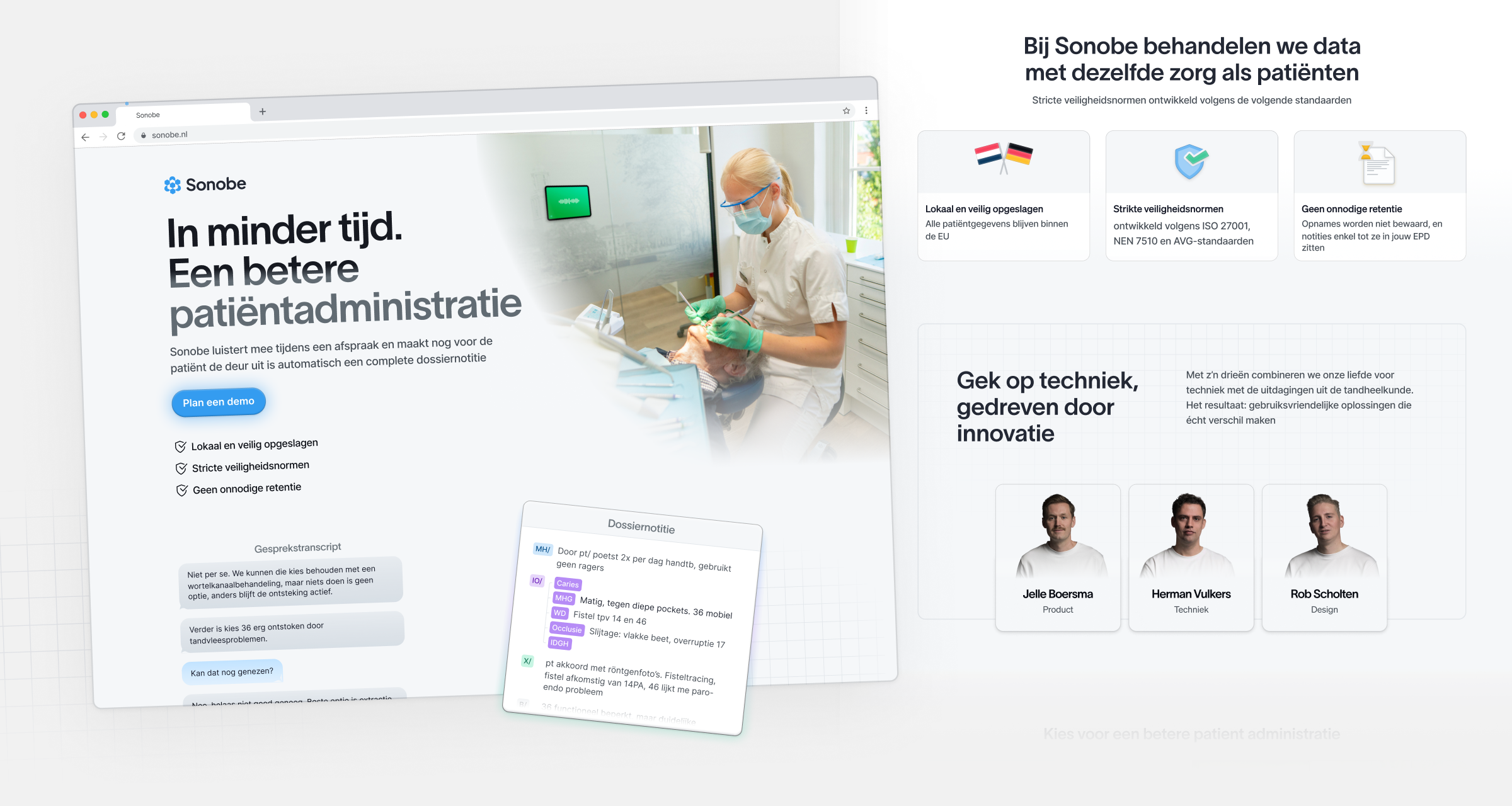
The brand identity brought this proposition together across the logo, colour palette, typography and broader visual language. It gave Sonobe a recognisable and consistent presence while making advanced AI technology feel more accessible and human. This complete product and brand experience became a working MVP and was installed and tested inside a real dental practice.
Impact
Sonobe progressed from an early concept through a substantial pivot to a functioning, practice-tested MVP supported by a complete and cohesive brand identity. Testing produced highly positive responses and demonstrated that ambient AI could support clinical documentation without demanding constant attention from the dentist. The project established a tangible foundation for further model development, integrations with established dental systems and a more scalable product.
For me, it became a formative lesson in co-founding a company, building a brand from the ground up, designing for a highly specialised professional environment and turning an emerging AI capability into a genuinely human-centred experience.