Streamlining transport operations at event sites
Context
Large events depend on a continuous flow of production crews, suppliers and logistics transports. When too many vehicles arrive at the same entrance, even a small disruption can quickly lead to congestion across the event site.
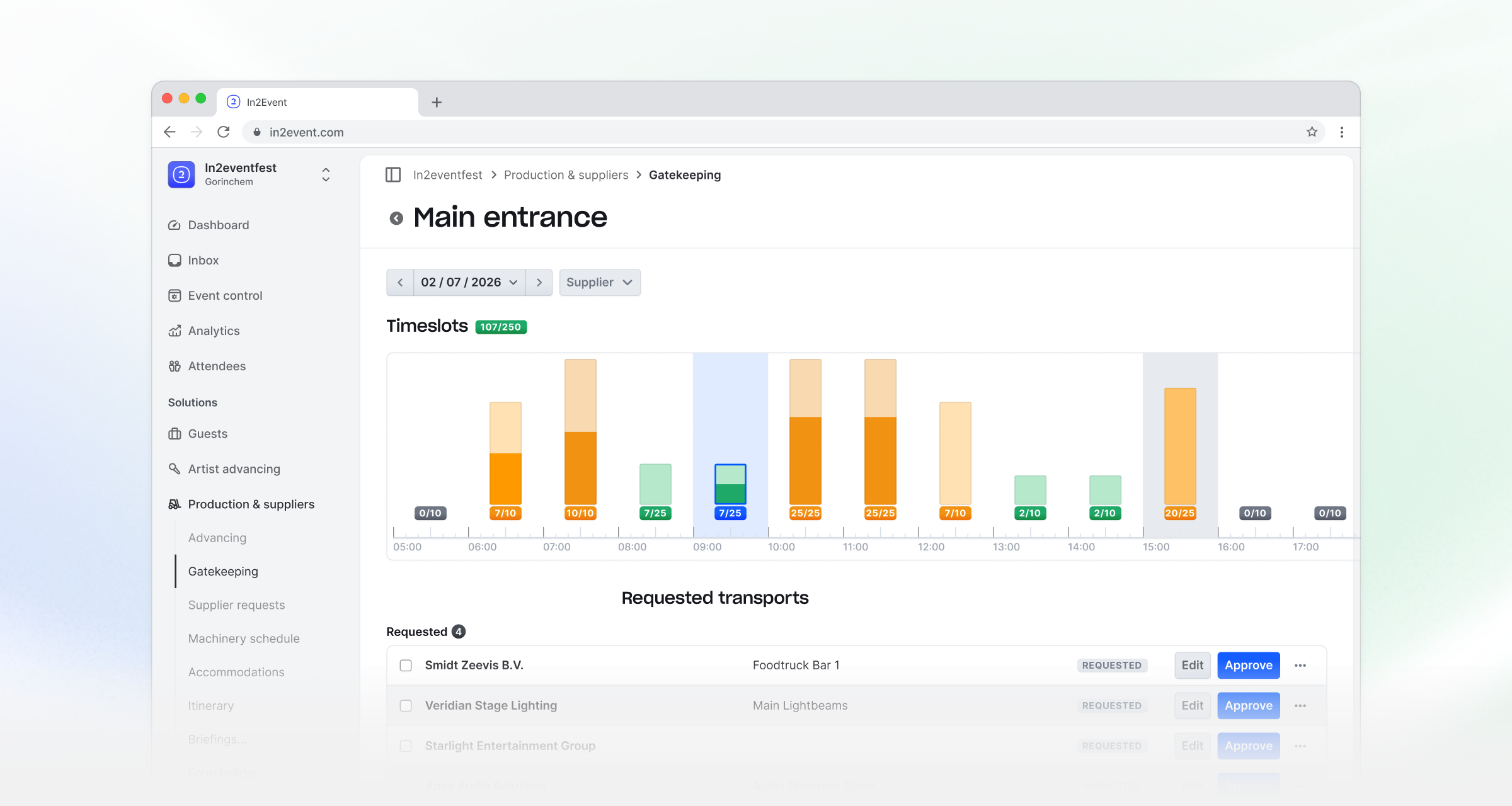
Gatekeeping was introduced within the Production & Suppliers module to give event teams control over this flow. It combines advance planning with real-time operational visibility, allowing teams to configure access points, regulate transport capacity and see which vehicles are expected, on site or already checked out.
Each gate operates within a defined date range and has opening hours for every event day. These hours are divided into one-hour timeslots, with individual capacity limits controlling how many transports can arrive during each period.
Challenge
Event teams had experienced situations where too many transports arrived at the same gate, causing traffic jams, overloaded entrances and operational delays. Unexpected events made this even harder to manage. During one winter event, snowfall caused trucks to become stuck at a gate, requiring other transports to be redirected at short notice.
Teams lacked a single overview showing which transports were expected, which had arrived, who was still on site and who had already left. Without that visibility, it was difficult to anticipate bottlenecks or respond quickly when circumstances changed.
The system also needed to collect information such as transport type, origin and fuel type. This data was required not only for logistics planning, but also to calculate the CO₂ emissions associated with event transportation.
Approach
I separated the experience into two closely connected operational stages: planning before the event and controlling transport during the event.
For pre-production, I focused on configuring gates, opening hours and hourly capacity. Each gate received a default capacity that could be applied across its schedule, while individual timeslots could still be adjusted when a specific day required different limits.
I then mapped the information needed to register and safely manage a transport. Suppliers provide their preferred timeslot alongside the transport type, licence plate, driver details, origin and fuel type. The licence plate supports identification at the gate, driver information enables direct contact during emergencies, and journey data creates the foundation for CO₂ calculations.
We collaborated closely with an event organisation that thoroughly tested Gatekeeping under real operational conditions. I visited the event site to observe the feature in use and see how gate personnel and production teams incorporated it into their workflow, giving direct insight into how the design performed outside a controlled environment.
The design also accounted for operational exceptions: warnings for conflicting opening hours, capacity reductions below the number of approved transports, and locking a gate that still had upcoming arrivals. Bulk actions, including copying schedules, applying opening hours across multiple dates and resetting overrides, helped keep complex event configurations manageable. An AI-assisted workflow helped the team move from detailed operational requirements to a working feature within four weeks.
Solution
Gatekeeping introduces configurable access points for every event site. Each gate has its own name, operational information, default hourly capacity and locked or unlocked state. Event teams can configure opening hours per day, after which the system generates timeslots with individual capacity limits.
Suppliers register their transports through a production or supplier request. Before the event, these requests enter a pre-production environment where organisers can review and approve them, assign the correct gate and timeslot, and move transports to another time or day when capacity becomes limited.
During the event, three complementary views support different operational needs: a kanban view follows transports through expected, checked-in, on-site and checked-out statuses; a timeline visualises gates and timeslots throughout the day; and a detailed list provides a searchable overview of every transport, supplier, arrival time and status.
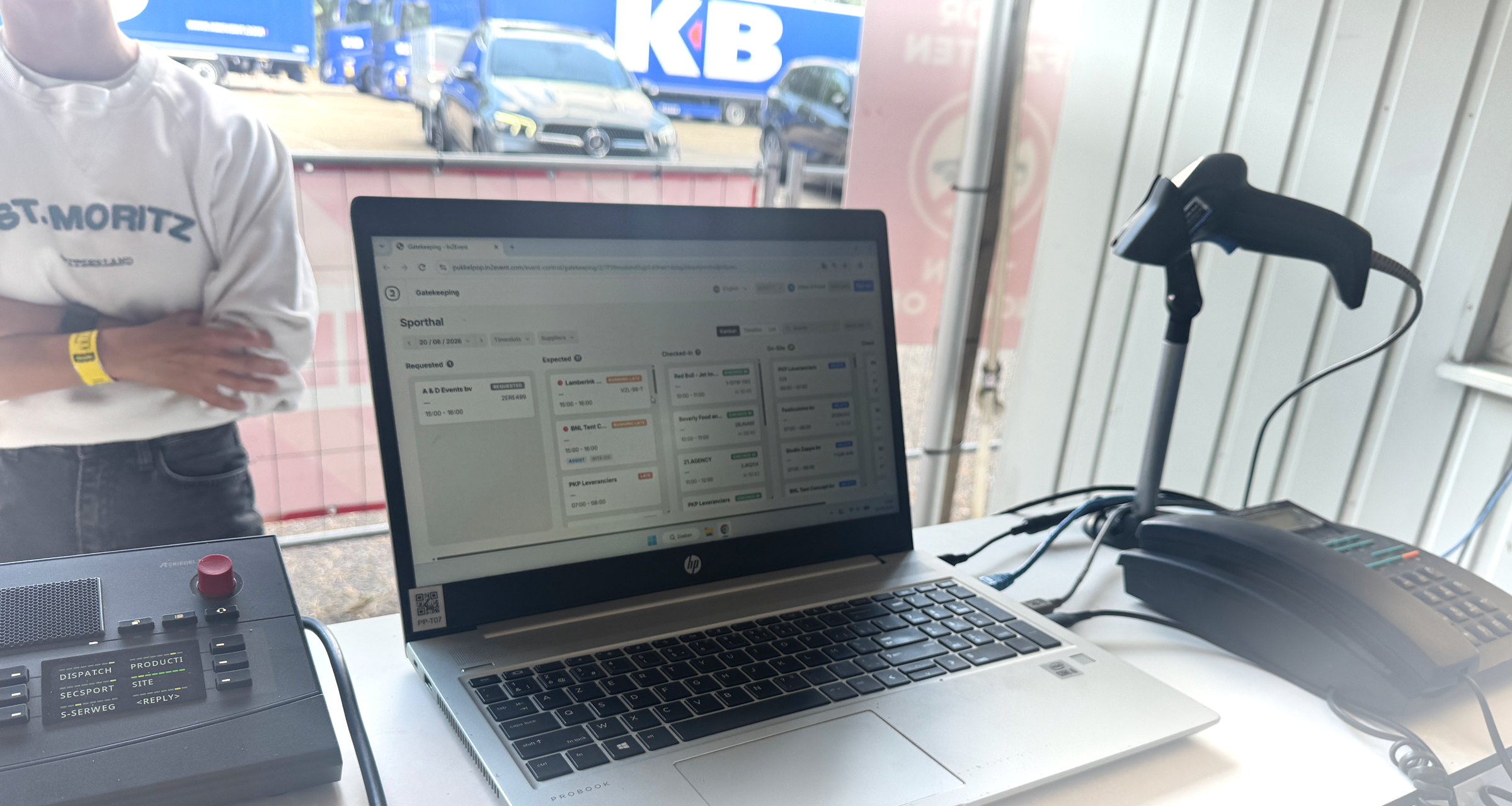
Users can filter by gate, event day or supplier and quickly move transports when circumstances change. When an entrance becomes unavailable, the gate can be temporarily locked and upcoming transports redirected. A secure external view also allows gate personnel to access live information through a shared link and PIN code, without receiving permission to change data in the system.
Impact
Gatekeeping introduced one operational framework for planning, approving and monitoring event logistics at scale. Built within four weeks with the support of AI, the feature was tested during an event welcoming more than 250,000 visitors. Observing it in operation demonstrated how controlled arrival capacity, live transport statuses and flexible reassignment could support a more predictable flow around the site. The collaboration also generated valuable real-world feedback, giving the team a stronger foundation for improving the experience beyond its initial release.